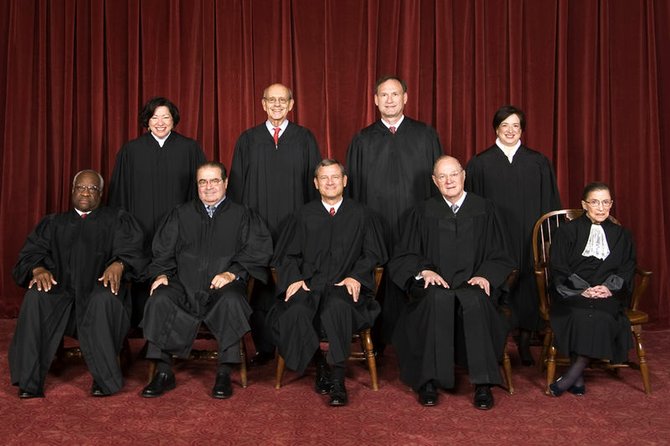
The Supreme Court of the United States: Top row (left to right): Associate Justice Sonia Sotomayor, Associate Justice Stephen G. Breyer, Associate Justice Samuel A. Alito, and Associate Justice Elena Kagan. Bottom row (left to right): Associate Justice Clarence Thomas, Associate Justice Antonin Scalia, Chief Justice John G. Roberts, Associate Justice Anthony Kennedy, and Associate Justice Ruth Bader Ginsburg. Photographed in 2010. Photo by Steve Petteway


In a 5-4 decision with Chief Justice John Roberts as the "swing" vote and author of the decision, the 2010 Affordable Care Act was upheld, including the controversial insurance "mandate," although as a tax. Roberts notes in the opinion that it would not survive the Commerce clause of the Constitution, but because the effect of not complying with the mandate is a "tax," then Congress does have that authority.
Read the JFP's 'Obamacare' and Mississippi story from Fall 2011 for a look at how the law is (and will) affect Mississippians.
Update: Live-blogging at http://scotusblog.com/, Amy Howe explains:
The Affordable Care Act, including its individual mandate that virtually all Americans buy health insurance, is constitutional. There were not five votes to uphold it on the ground that Congress could use its power to regulate commerce between the states to require everyone to buy health insurance.
However, five Justices agreed that the penalty that someone must pay if he refuses to buy insurance is a kind of tax that Congress can impose using its taxing power. That is all that matters
Because the mandate survives, the Court did not need to decide what other parts of the statute were constitutional, except for a provision that required states to comply with new eligibility requirements for Medicaid or risk losing their funding. On that question, the Court held that the provision is constitutional as long as states would only lose new funds if they didn't comply with the new requirements, rather than all of their funding.
More stories by this author
Support our reporting -- Follow the MFP.