
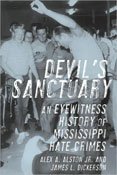
Mississippi Values: It sounds innocuous, even noble; yet under the pens of Alex A. Alston Jr. and James L. Dickerson, the phrase takes on an ominous ring. Magnolia State residents "have a long history of being against whatever the rest of the nation is for," the authors write in "Devil's Sanctuary: an Eyewitness History of Mississippi Hate Crimes" (Lawrence Hill Books, 2009, $26.95), beginning with the white settlers who came to escape the "liberalism" of the Founding Fathers. Their self-evident truths did not include equalitynot for the slaves imported into the state and not for the Native Americans exported out.
The civil-rights era exposed a particularly evil quality of the phrase: "Mississippi Values" meant preserving the dominance of the white race, barely hidden behind a diaphanous, blood-soaked cloth woven with religious and patriotic fundamentalism.
Led by white supremacists like Gov. Ross Barnett and Sen. James "Big Jim" Eastland, anti-integrationist Mississippianshidden behind pointy Klan hoods or tin police badgesregularly bombed, tortured and murdered with impunity. Buoyed by state-sanctioned defiance of federal authority, they knew they would get away with it.
"Devil's Sanctuary," though, is more than just a retelling of those dark days, although it never shies from them. Interspersed with meticulously researched reporting of infamous acts of domestic terrorism and the trials of their perpetrators, Alston, a Mississippi lawyer, and Dickerson, a Jackson-based journalist, open themselves up, recounting the "normalcy" of their segregationist, small-town Delta lives.
"The day my destiny called, I was three," Dickerson writes, recalling his mother's encounter with a neighbor over Sallie Mae Elle, the woman who cared for him, in 1948. The neighbor, clearly agitated, came to the bank where Dickerson's mother worked.
"When the woman reached the window, she didn't lay down a wad of cash or a check. She wasn't there on banking business. She leaned over into the window, her voice low and ominous, whispering, х Did you know that that n*gger you hired is bringing her little boy to the city park to play with your baby?'
"Stunned, Mother said she didn't know anything about that, which was the truth.
ӒWell, I thought you ought to know,' the woman said; then she turned and left."
With the town's white opinion against her, Dickerson's mother neither punished Sallie Mae nor insisted their sons stop playing together.
"In my first act of civil disobedience, we played on the swings and slides, and we chased each other across the rich Delta grass," Dickerson writes. His mother's decision to do the right thing set him up with "an appreciation of black culture, never fearing blacks or hating them. And it made all the difference."
Alston's first encounter with an African American came in 1942, when he was about 7. His father was one of several men who chased down a black man caught stealing who dared to fight back. "They didn't tell me what happened to him," he writes, "but by the manner in which the posse looked, talked and bragged, even as a young boy I felt sure this guy never again saw the light of day."
Nevertheless, the incident "had almost no impact on my view of blacks," Alston writes. "The word n*gger was commonly used to refer to any African American, and the resulting punishment for striking a white man was not unexpected. We lived in a caste system that tolerated no deviation from the rules."
Those rules dictated that whites dominate every aspect of Mississippi society, from the church pew to the jury box, and from "whites only" restrooms to the Legislature, judiciary and law enforcement. The authors' disclose how the "Mississippi Gestapoԗthe Mississippi Sovereignty Commissionkept everyone in line with its investigations and intimidation tactics backed by the Klan, the state and even the FBI. Congregations and preachers hid behind "Mississippi Values," running dissenters out of town, and with a few notable exceptions, the state's media went along with the whole witches' brew of race hatred.
"Individuals do not commit despicable acts with an expectation that they will go unpunished unless there is a pervasive belief throughout the culture that odious acts can be justified in certain situations," the authors write: "That wasand still isthe case in Mississippi."
Today, touting "Mississippi Values" tells whites which candidates to trust, the author's say, keeping the state enslaved to its racist roots, and keeping it the poorest, least healthy and worst educated state in the union. And while we are busy "redacting" the state's past, "behaving like an animal covering up its wastes in a befouled nest," we would be better off, in the words of Eudora Welty, to "part a curtain the veil of indifference to each other's presence, each other's wonder, each other's human plight."
"Devil's Sanctuary" will stand as an important addition to our understanding of the dark days in Mississippi and their costdays that should not be forgotten at the risk of repeating them.
Alex Alston and James Dickerson will sign copies of "Devil's Sanctuary" at Lemuria Thursday, July 9, at 5 p.m. Call 601-366-7619.
More stories by this author
Support our reporting -- Follow the MFP.


Comments
Use the comment form below to begin a discussion about this content.
comments powered by Disqus