
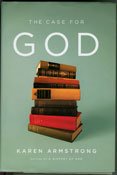
In her newest book, Karen Armstrong expands on a premise I first came upon in her 2001 book, "The Battle for God," in which she wrote that religious fundamentalism is a thoroughly modern invention, unheard of prior to the late 19th century. In "The Case for God" (Alfred A. Knopf, 2009, $27.95), she expounds diametrically on this polemic, while providing a thump on the head to contemporary atheists like Richard Dawkins and Christopher Hitchens.
Both campsfundamentalists of all religions and the atheists who propound that a "fantasy" god is absurdhave a similar, over-simplified and anthropomorphic view of God, she writes, far removed from religion's roots. They have a common basis: uninformed theology. The factions are two sides of the same late-minted coin.
Armstrong has impressive theological bona fides: author of numerous books on the world's religionsincluding biographies of Buddha, Mohammed and St. Pauland impressive scholarly tomes historically documenting, comparing and contrasting the world's religious movements; Armstrong is also a former nun. On the basis of her work she advises governments (including that of the U.S.) on the issues of religion and foreign relations, and is a U.N. ambassador for the Alliance of Civilizations. When it comes to religion, especially the three Abrahamic religions (Christianity, Judaism and Islam), Armstrong has done the grueling work of understanding their history, philosophy and theology thoroughly, as evidenced by the voluminous notes and bibliographies for each of her books.
Trying to understand God, she writes in "The Case for God," should be hard work. Religion, in both the eras preceding the documentation of our great sacred works and for centuries after their publication (and into the present day for many theologians), provides the framework for profound, spiritually life-altering transformation. The mysteries (which originally referred to reality hidden from ordinary sight that exists beyond the reach of language) were a gift to those who performed the difficult journey of initiation into spirit-filled adulthood. The stories of the Torah, the Bible and the Qur'an were never meant to be taken literally, Armstrong repeatedly writes, but provide models for good, compassionate lives (or the consequences of badly lived lives).
As Armstrong recounts, the Torah, according to one rabbi, has only one basic lesson: Do to others as you will have others do to you. Everything else, he said, is commentary.
From the days when our prehistoric ancestors painted fantastical pictures on cave wallsthat are still enormously difficult to accessmankind understood that God was "utterly transcendent" and limitless, Armstrong writes, beyond our mind's capacity to name or define (literally: to limit). God was "not this, not that," reminiscent more of a Zen koan than a biblical verse. Religion provided us with practices for living godly lives. Ritual, prayer, meditation, yoga, charity, rigorous engagement with sacred texts and other practices are all pathways toward religious enlightenment, by whatever name you choose to call it. These practices are the rocks upon which the world's religions were built, yet for many, are no longer requisites for spiritual understanding. Rather, we want religion to be easy.
The Enlightenment and its numerous scientific breakthroughs radically changed our concept of God, Armstrong writes. Not, she says, by creating science as the antithesis of religion, but through religion's enthusiastic embrace of scientific proof for all thingsincluding God. Prior to the 18th century, theology (and science) held that God could not be known through the natural world, and even giants like Newton, Einstein and Darwin agreed that sacred knowledge was "unknowable" through scientific methods.
That embrace, however, has reduced God to the universe's ultimate engineer and mechanic. Science and religion has held that view for hundreds of years, Armstrong says, yet many scientists are returning to "mystical wonder," understanding that science can no more define God than a finger pointing to the moon defines the moon.
"The most beautiful emotion we can experience is the mystical," Albert Einstein wrote. "It is the sower of all true art and science. He to whom this emotion is a stranger is as good as dead. To know that what is impenetrable to us really exists, manifesting itself to us as the highest wisdom and the most radiant beauty, which our dull faculties can comprehend only in their most primitive formsthis knowledge, this feeling is at the centre of all true religiousness. And in this sense, and in this sense only, I belong to the ranks of devoutly religious men."
Armstrong writes that "we have lost the 'knack' for religion." Insisting that God can be defined by scientific proof means that God can also be refuted by it. Yet one can't scientifically prove a spiritual experience any more than a symphony or a poem. Like art, religion lies in the experience. By becoming facile with our religious practices, we become believers in the symbols of religiosity instead of its skillful, active practitioners. In a scientific context, myth becomes exactly what modern atheists say it is: fantasy. God is a "super" version of a human, instead of "being" in and of itself. Instead of God as love, God has become one who loves; instead of compassion, he is compassionate. Instead of heaven or hell as ego-driven human states, they have becomes places separate from and outside of our human experience.
Ancient theologiansthose who wrote our sacred textswould see our current view of God as idolatry, Armstrong writes.
"Any image of the divine is bound to be inadequate, because it cannot possibly express the all-encompassing reality of being itself. If that symbol is a personalized deity, (people) could easily start to imagine "him" functioning as if he were a human being like themselves writ large, with likes and dislikes similar to their own."
At its core, "The Case for God" is both hopeful and brilliant, while always challenging and sometimes infuriating.
By reengaging with God through "strenuous and committed" religious practice, Armstrong suggests that we can bring our world back from the infantilism of our literalist viewpoints, which, by their very nature, cannot allow competing fundamentalist viewpoints to exist. Religion, she writes, can make it "possible for mortal men and women to live on a higher, divine or godlike plane, and thus wake up to their true selves."
For any serious student of spirituality, "The Case for God" adds layer upon layer to historical and philosophical understanding. Beyond simplicity, it is also a spellbinding human story.
More stories by this author
Support our reporting -- Follow the MFP.


Comments
Use the comment form below to begin a discussion about this content.
comments powered by Disqus