
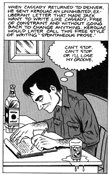
"The Beats: A Graphic History" (Hill and Wang, 2009, $22) is a graphic biography of the close-knit group of avant garde macho writers of the 1950s and '60s like Jack Kerouac, Allen Ginsberg and William S. Burroughs who were referred to as "the Beatniks" or "Beats." At a time when American society was defining itself through suburban expansion, commercial development and a clean-cut conformist ideal, the Beats led lives as drifters and counter-culturists. "The Beats" is a collection of short stories about these writers, mostly written by alternative comics king (and subject of the indie film "American Splendor") Harvey Pekar and drawn by his longtime artist Ed Piskor.
While the Beat writers romanticized their own lifestyle, Pekar's script takes a more clinical look at the writers' lives, never hesitating to show the casualties of their often parasitic existence. Piskor's art is expressive, with each character displaying a wide range of emotions that convey the tone of each scene.
One drawback of the book is that the art and writing don't necessarily work together in a way that highlights the strength of a graphic novel. Most panels involve Pekar writing a caption of something that happened while Piskor illustrates that caption. This structure made it difficult for me to immerse myself in the world created by the art, rather than the formulaic pairing of illustration to text.
An exception to this critique is found in a scene of William S. Burroughs tragically shooting his wife Joan Vollmer while they are both intoxicated and playing a game of "William Tell." Piskor illustrates Burroughs firing his pistol off the page while a caption narrates the date and what happened. Sixty pages later, in Burroughs' story, a symmetrical panel shows Joan falling backwards, the bullet entering the panel from the left side of the page. It's a powerful payoff to the earlier panel, and illustrates how Pekar's deceptively minimal script was able to distill and weave together the shared histories of these three men.
Piskor's depiction of Burroughs is predatory throughout, with sunken, bloodshot eyes and a shifty countenance. His seeming revitalization at the end of his life is a contrast to the negative existence he apparently lived throughout most of his life.
Ginsberg emerges triumphant throughout the book, appearing as a stabilizing force in the other writers' stories while evading their self-destructive tendencies and becoming a lifelong political activist and steward of the 1950s Beatnik movement into the hippie-influenced 1960s. His performance of explosive "Howl" in San Francisco on Oct. 7, 1955, is a significant moment for the hippie generation and makes him an instant heavyweight. Piskor ably draws the world landmarks in Ginsberg's subsequent travels, helping to create a sense of how influential Ginsberg became worldwide.
The second half of the book, made up of shorter stories featuring less famous stalwarts of the Beats, is an introduction to the characters who, unlike Kerouac, haven't entered the cultural vernacular.
"Beatnik Chicks," written by Joyce Brabner and photorealistically drawn by Summer McClinton, also appears in the book and stands out as a force among the shorter stories. It describes the women who were often overshadowed by the Beats' unapologetic misogyny, some of whom created notable art and writing in their own right. Brabner depicts the resilient nature of the Beat women and the bravado of the Beat men when she quotes Diane di Prima: "Holding her own meant keeping the work going somehow. Not allowing it to be snowed under by the work of her lover or his demands. … She held on, carving her path with or without role models."
Ultimately, "The Beats: A Graphic History" is exactly what it claims to be: a history of a pivotal movement and the community that allowed it to flourish. If you're looking for the actual works by these writers, this graphic novel is no substitute for their own visceral language.
"The Beats: A Graphic History" is available at Lemuria Bookstore located in Banner Hall. For bonus hipster points, find the signed photo on the wall of Lawrence Ferlinghetti, owner of San Francisco's City Lights bookstore, a renowned poet and publisher of much of the Beats' work.
So you've already read the Beats, what's next? Try these modern favorites:
• "Some Ether" by Nick Flynn. Flynn's poetry is accessible and prose-like, similar to the Beats, and he deals with masculine, autobiographical topics.
• "The Savage Detectives," by Roberto Bolaño. Bolaño's novel, only recently translated to English, describes two South American poets who have dubbed themselves the Visceral Realists and travel throughout the continent having adventures. Told from the perspective of those who encounter the poets, it constantly asks the question of whether their lifestyle is really freewheeling adventure, or if they're merely losers.
More stories by this author
Support our reporting -- Follow the MFP.


Comments
Use the comment form below to begin a discussion about this content.
comments powered by Disqus