
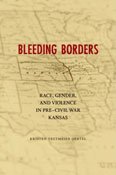
The war between North and South began in the West. In the 1850s, the fight over whether Kansas would allow slavery became so violent that it ignited the Civil War. As the guerilla war between southern "ruffians" and northern "jayhawkers" escalated out of control, the nation called it Bleeding Kansas.
Now, an important new book from a historian at Millsaps College sheds new light on the struggle in Kansas. The book is "Bleeding Borders: Race, Gender and Violence in Pre-Civil War Kansas" (Louisiana State University Press, 2009, $32.50) by Kristen Tegtmeier Oertel.
Kansas became the focus of struggles over slavery because for the first time, the question of whether a state would allow slavery was to be settled by a vote. The result was a flood of settlers from North and South, as each side tried to gain a numerical advantage.
In the early years, southerners from Missouri and Arkansas crossed into Kansas in great numbers and managed to pass laws that were among the most favorable to slavery in the nation. These settlers often resorted to violence to intimidate those who opposed slavery.
However, they faced growing resistance from free-state settlers. Driven by "evangelical abolitionism," free-state settlers were initially ambivalent toward violence but eventually took up "Beecher's Bibles," their nickname for the Sharps rifle. Abolitionists ultimately won the vote in Kansas just months before the rest of the country descended into the Civil War. The fire that began in Kansas was not extinguished until cities like Jackson and Atlanta lay in ruins and half a million Americans were dead.
This story has been told elsewhere at great length, but historians have traditionally focused on white politics. By viewing the struggle in Kansas through the lens of gender and race, Oertel offers fresh insights into how abolitionists won and why their victory did not translate into greater opportunities for former slaves.
The chief challenge pro-slavery settlers faced in establishing slavery in Kansas was the constant threat that their slaves would run away. Working together, blacks and whites smuggled slaves to safety on the Underground Railroad, which ran through abolitionist outposts like Lawrence, Kan., and on to Chicago. Abolitionists threatened the institution of slavery not only in Kansas but in neighboring Missouri as well, for a slave who could make it to Kansas stood a good chance of escaping for good.
Slave owners twisted themselves into knots in an effort to preserve the myth of the docile, contented slave, blaming white "Negro stealers" for black resistance. Oertel tells the story of a slave named Lucinda who drowned herself in a river to escape her alcoholic, abusive master. Her master blamed a local abolitionist for "inciting slave suicide." He beat the abolitionist severely and dragged him into the center of town, where a pro-slavery mob tarred, feathered and exiled the man. Even a slave who made the ultimate act of resistance got no credit.
Pro-slavery vigilantism should be familiar and chilling to readers in Mississippi. Southerners described themselves as the "Law and Order Party" defending home, church and private property from "northern radicals." Southerners were eager to defend the law by taking it into their own hands. They mocked northern men for their reluctance to engage in duels, describing them as effeminate and dependent on their "unsexed" women for protection. The stupidity of this machismo makes for painful reading, considering that only a few years later, war would destroy much of the South.
Perhaps the most illuminating parts of Oertel's book concern gender. Pro-slavery settlers believed that women should be "simple, obedient girls who dared not question their place in society," and they often left their women behind as too frail for the frontier, undermining their claims to the land. Abolitionist women, by contrast, took active part in the struggle and proved crucial to the triumph of the free-state movement.
Northern aid societies sponsored sewing circles and raised money to support free-state homes. Women gave fiery speeches about the need to oppose slavery, upsetting men who believed that women had no place in public life.
As violence spread, women smuggled weapons in their skirts and stockings, relying on sexism to protect them from suspicion and search. Some abolitionist women even took up arms to fight at the sides of their husbands and sons.
Yet, for all their abolitionist zeal, free-state settlers remained deeply committed to white supremacy. Indeed, Oertel demonstrates that the fight over slavery was largely an argument over which side better served white interests.
Pro-slavery settlers presented themselves as the proper champions of white supremacy, planting a "master race" on the frontier. They called white abolitionists "Black Republicans," in much the same way that "Democrat" is used as a slur for "black" in certain quarters of Mississippi today. Pro-slavery settlers accused free-state men of promoting an abomination of mixed races, where white women would be unprotected from black sexual advances.
Free-state settlers countered that it was slave-owners who mixed the races, when masters had sex with slaves. All offspring of these unions were slaves, which meant that the white blood of "orators, statesmen, generals, and even Presidents, flows in the veins of thousands, who are bought and sold like mules and horses."
Most abolitionists hoped to preserve the frontier for white men, and some even tried to ban black men from the territory altogether. Thus, many free-state settlers fought against slavery to preserve white supremacy.
If free-state settlers were originally reluctant to use violence, that changed when a group of Missouri ruffians burned down parts of Lawrence in 1856.
The destruction of Lawrence shocked the nation. Sen. Charles Sumner of Massachusetts responded with a speech criticizing southern violence, prompting Rep. Preston Brooks of South Carolina to brutally cane Sumner on the senate floor. This incident further polarized the nation, preparing the way for war.
Following the sack of Lawrence, free-state settlers embraced armed resistance, organizing militias to defend abolitionist settlements from further attacks. One abolitionist woman wrote, "We never prayed for the destruction of men, made in the image of their Maker, but if they persist in killing and torturing our innocent citizens, let the sword be driven in to the hilt!" The Topeka Tribune announced: "We are glad that the issue is thus finally reduced to one single, starting point: annihilation. We are ready."
John Brown responded to the sack of Lawrence by brutally murdering five pro-slavery settlers in what came to be called the Pottawatomie Massacre. Three years later, Brown led the raid on Harpers Ferry, West Virginia, hoping to incite a slave uprising. This event was the last stop on the road to total war.
Kansas sent a greater share of its men to fight in the Civil War than any other northern state, and jayhawkers and ruffians clashed along the Missouri border throughout the war. Lawrence was burned down again in 1863, making it something of a sister city to Chimneyville.
Yet, Oertel shows that even as abolitionists won the war, white supremacy reigned supreme. Kansas became a free state, but with segregated schools. Nearly a century would pass before Brown v. Board of Education of Topeka, when Kansas would once again be at the center of the fight for American rights.
Signed copies of "Bleeding Borders" are available at Lemuria.
Previous Comments
- ID
- 152007
- Comment
I want to give this review a bump. If you're a Civil War buff, you must read this book by Millsaps professor Kristen Oertel. It really opened a window for me into the 1850s, when increasing violence by both abolitionists and defenders of slavery led the country to war. Highly recommended.
- Author
- Brian C Johnson
- Date
- 2009-09-17T10:23:28-06:00
More stories by this author
Support our reporting -- Follow the MFP.


Comments
Use the comment form below to begin a discussion about this content.
comments powered by Disqus