
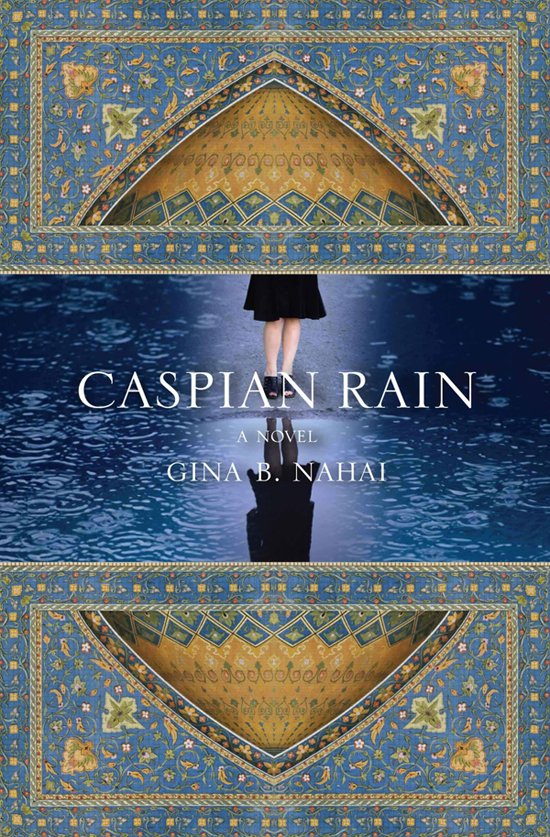
The beginning of Gina B. Nahai's "Caspian Rain" (MacAdam Cage, 2007, $25) is almost fairy tale-like, sighing with promise and expectation: "She's sixteen years old—a young woman in a city with blue mountains." A young Jewish girl growing up in the slums of South Tehran, Iran, meets the son of wealthy Iranian Jews and gets the chance of a lifetime to leave the bondages of her upbringing. In her mind, this wealthy and handsome young man is going to fulfill every one of her dreams, and at first, we are convinced that he will as well.
After the couple becomes engaged, Omid, the young man, brings his fiancée, Bahar, beautiful cloth to make her engagement dress. He places green fabric in her arms, green like the Caspian Sea. This token overwhelms her because she has always dreamed of the sea, and she told Omid green was her favorite color. Readers can feel her soaring sense of hope, and believe—just as she does—that all her dreams will come true.
Yaas, Omid and Bahar's 12-year-old daughter, narrates the story of her parents' early relationship and present life, describing the pain and tragedy that was destined for two socially unequal lovers. She tells of her mother's naïve hope for a life of love and fulfillment and how, instead, she is doomed to a failed marriage. The gradual loss of Bahar's hopes parallels that of Yaas' hearing, brought on by a rare disease.
Eventually, the force driving the story transitions from Yaas' parents to Yaas herself. We start to get inside her head, and start to understand her perspective of her parents' marriage, instead of her just telling the back story. One line early during this switch in perspective helps to signal that we are now seeing this story through new eyes. "… I would reach for Bahar and Omid and find them each standing on the edge of an even greater divide—of longings and desires—his, hers, mine—that opposed each other." Even as we start to see the story through Yaas' eyes, there is also the sense that she has not truly been able to separate her life and her story from that of her mother's. Indeed, as the story progresses, we see that Yaas' entire life, both its victories and defeats, are completely wrapped up in Bahar's life.
Yaas has a tragically twisted relationship with her father. While he is almost solely responsible for the pain in her family (he has rejected her mother and is having an affair with a beautiful Muslim woman), he also represents all of the hope that Yaas holds in her heart: hope that her father will someday come to love her and her mother; hope that he will take her with him when he decides to leave with his lover.
On the surface, "Caspian Rain" is about how the decisions we make affect not just our lives, but the lives of those we love as well. But I think the true meaning is much deeper, much more complex. I think it's about trying to find the ways to pick up the pieces whenever those around us choose to make decisions, either good or bad, that affect our lives.
Nahai's writing is poetic and lilting, with sentences that alternate between soft fragments and lines that run on into one another. Her style is easy to read, as words and sentences and even chapters run gently together. However, much like the ever-present and mysterious Ghost Brother—the spirit of Bahar's brother who died in a childhood drowning accident—who keeps making appearances throughout the book, we are constantly reminded that below the surface is deep, dark pain and disappointment.
The dialogue is limited, and even when it is there, it takes place inside Yaas' head. This facet of Nahai's writing works well, especially as Yaas starts to lose her hearing, and she muses about trying to memorize sounds, like her mother's voice or the music from the Tango Dancer, a free-spirited woman who moves into the neighborhood, much to the chagrin of the neighbors, and plays her records at all hours of the night.
At first reading, I was left with a sense of total loss and helplessness at the end of "Caspian Rain." I kept expecting some sort of redemption, but instead the book closes abruptly. Perhaps, though, the entire book is redeemed by two simple sentences, tucked away near the end of the book, almost lost at the bottom of the page: "What is a life, at the end, but a story we leave behind? What if that story was never told?"
More stories by this author
Support our reporting -- Follow the MFP.

Comments
Use the comment form below to begin a discussion about this content.
comments powered by Disqus