
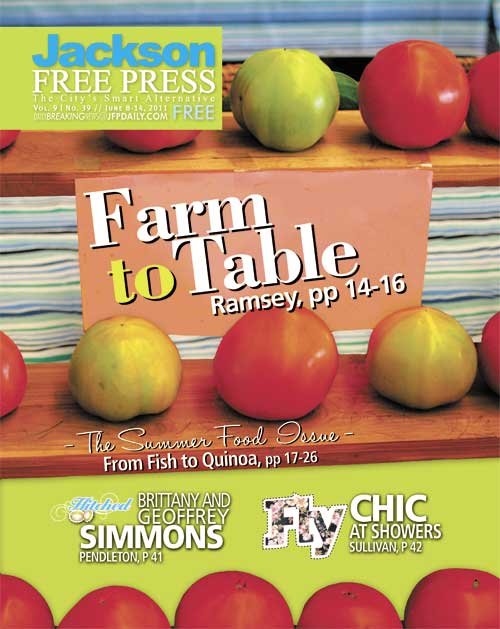
Photo by Tom Ramsey
It sounds like such a simple concept. Farmers grow food; restaurants cook and serve food; customers eat food. Easy, peasy, one-two-threesy.
If only it were that simple. Competing forces of regulation, supply and demand, transportation, reliability of source, supply-chain management and other concerns too numerous to count stand up like an endless row of sentinels blocking the way for food to get from the ground to your fork.
"Do away with nanny-state government regulations!" shouts one side.
"Keep food affordable!" bellows another.
"Protect my children from harmful chemicals!" yells yet another.
And the cries continue...
"No irradiation!"
"No genetic modification!"
"More variety!"
"More freshness!"
"Year-round availability!"
We've grown accustomed to being able to fill our carts with avocados, strawberries and cherries far out of season. So far that
our selections could rack up enough frequent-flier miles to take a family of four on a European vacation.
At the same time, we opine about the virtues of labels like "organic" or "local"
or "free range" so that we've pretty much muddied the water beyond any hope of seeing the bottom.
We can't satisfy everyone when it comes to food, so what do we do? We settle. We eat food that is partially tasteless, anonymously sourced, inexpensive and, most of all, convenient. So often, our level of commitment to eating well is perfectly inverse to our threshold for inconvenience. It's as if our willingness to march ends with slight foot discomfort. It's hard to be an activist when everything is just so damn easy. If we want coffee, bang! There it is: 40 brands at the end of your arm. Want yogurt? Take your pick. Greek, plain, low-fat, no-fat, fruit on the bottom, even in a little disposable pouch if you are too burdened by the use of a spoon.
We are disconnected from our food. It has become tasty, tasty fuel and a source of amusement. Perhaps this is why the farm-to-table movement has been so slow to launch. It takes real commitment. You have to sacrifice. You have to even bother with a bit of education and that can be a bit tiresome.
So for the time being, farm-to-table is relegated to the miniscule population of diehards and early adopters. But perhaps it will catch on—like "organic" and "free range"—to find a wider audience.
Enough of my soapbox rant.
So what does "farm-to-table" mean, anyway? Essentially, the practice cuts out as many middlemen as possible between people producing the food and people eating the food. In its simplest form, a customer buys food directly from a farmer and cooks it. One step removed, a restaurant buys food from farmer, and then cooks and serves it to their guests.
Here is where it gets a bit tricky. Restaurants like to know that they can get the same stuff on a regular basis, so they turn to established vendors. Those vendors supply more than just one restaurant, so they have to buy from producers who can meet their demand. So instead of buying sweet potatoes from Ned's farm and strawberries from Alice's patch, they buy from large farms and growing co-operatives. These vendors must also meet strict health guidelines, and only buy from inspected and approved producers, which mostly turn out to be the same large farms and growing co-ops. And here we are, back at square one.
The wiggle room is generally found in privately owned, higher-end restaurants. They have the flexibility to change their menus on demand and can purchase smaller quantities. These types of restaurants frequently look for ways to differentiate themselves from their chain counterparts and justify their higher prices. "Sure, you can get a McWhopper Double with cheese, but wouldn't you rather have a hand-formed, burger made from a steer fed on the sweet grasses on the plain over at George's ranch?" they posit. "It'll cost you more, but it'll be well worth the extra bucks."
The irony is that in days long past, poor folk had to grow their own food and raise their own animals. This was hard work. Poor folk were fit, and rich folk were fat. "Fat cats" was a description of wealthy people because they could afford more food and spend more time sitting on their duffs. Now, the tables have completely turned, and obesity is a plague on the poor, far more than it is on the wealthy.
So what's the fix? How can we, residents of a state with some of the richest farmland in the world, find a way to use that land to feed our own people on healthy foods? How can we stop buying the corporate, processed, nutrient-deficient, marketing-enriched foods found in the center part of the super-market?
To help answer those questions, I asked a chef, a produce vendor, a farmer, a hippie and a bureaucrat. Here are their suggestions.
Where Food Comes From
Jay Pilgrim is a multi-generational farmer, and his 13-year-old son, Michael, is ensuring that the business stays close to the land. At their farm on Highway 35 outside of Raleigh, Miss., they produce (among other things) okra, squash, melons, cabbage and some of the best tomatoes I've seen this season.
Pilgrim is a regular fixture at the Mississippi Farmers Market on High Street every Tuesday, Thursday and Saturday (all the days the market is open), and he has noticed a steady growth in his business, most of which he attributes to word-of-mouth marketing.
"People taste these tomatoes and love them," Pilgrim says. "Then, when they run out, they go to the grocery store and buy something from California and Mexico, and that's when they really get the difference. Ours just taste better."
He's right. His 6,000 tomato plants put out beautiful fruit, but when they're gone, they're gone. His customers still want tomatoes, so they go back to the grocery store and buy an inferior but readily available product.
"Customer education would be the number one thing that could be done to help people buy local produce," he says. "Folks just need to know more about what is fresh and in-season, and what isn't."
Andy Prosser couldn't agree more. Prosser is director of market development with the Mississippi Department of Agriculture. His job is to get that message out. He doesn't have much of a budget for advertising and public awareness, but he does have the most powerful tool of all: that word-of-mouth advertising that farmer Pilgrim spoke of.
"One of the biggest hurdles we face in getting local produce on the table is that people don't understand the growing season and why everything isn't available all the time, all year-round," Prosser says. "There's only so much our agency can do to educate people about growing cycles. Some time ago we, as a people, dropped the ball and stopped teaching our kids about where food comes from. If you ask a kid where fruit comes from (or milk or meat for that matter) they say 'From the grocery store.' They don't see the link from the farm to the fridge."
Prosser also laments how the ease of prepared foods trumps the value of local and fresh food.
"Our society wants things here and now," he says. "It takes personal will to eat fresh and local. We don't sell meals here at the farmers market; we sell ingredients. You have to take this stuff home and do something with it. You just can't unwrap it, slide it on a plate and nuke it. It takes work, but in my mind, it's worth it. We just need more and more people to understand that."
On a national level, some of that is changing. The Obama administration has made a big deal out of the White House vegetable garden and the importance of fresh food. The U.S. Department of Agriculture has scraped its old food pyramid for a much easier to understand "plate" showing how much of any food group we should have in a day.
At the market today (and on most of my visits there), I notice that the clientele is mostly affluent. This is where I see the most room for improvement. The fact that the market now accepts EBT cards from the SNAP program (aka "food stamps") is a step in the right direction. But again, it gets back to the need for education.
The 'E' Word
One step removed from the market and another step removed from the farm are restaurants. Again, the notions of education and instant gratification come to the surface.
Dan Blumenthal has a fairly unique view from the commercial kitchen. He operates three very different restaurants and has to look at varying buying patterns for each one.
"At Sal & Mookie's, we have a little garden out back where we grow basil and tomatoes, but it can't even scratch the surface of the volume we need, so we have to work with a large produce supplier to keep the product consistent," he says. "At BRAVO!, we have the flexibility to use local produce and ingredients in our specials, and customers really love it. The problem we run into is when that customer returns and wants the same dish they had for a special the week or month before. We try to explain that those items were seasonal, but they are used to seeing everything they want in the grocery store."
"It's all about sustainability," Blumenthal adds. "If you don't have the flexibility to constantly change your menu, it's hard for local vendors to supply you with everything you need, when you need it."
This flexibility is exactly what Craig Noone built Parlor Market restaurant and his menu around. When Noone and I first met, he described his menu as "crazy local" and went to great lengths to demonstrate just what he meant. For a good portion of his menu, he knew not only the state of origin, but also the name of the farmer. Because he didn't have a book of regular customers asking for their regular dishes, he was able to come out of the gate with a new menu every season.
"If it was a possibility, I'd have a 100 percent local menu, but it's just not a reality. I'm shooting for 80 percent in the next five years," Noone says. "With the exception of some things like fiddlehead ferns and rhubarb, almost all of our produce at least comes from the southeast. If we can't get it local, we at least try to keep it from spending too much time on a truck. We want Parlor Market to be a 'southern' restaurant in every way we can."
Noone has taken it a step further. In addition to buying from the Mississippi Farmers Market, he and his chef, Jesse Houston, have been involved in the formation of the Farmers Market at Livingston Township. This new market will open the first week in June at
the intersection of highways 463 and 22 in Madison County.
"We spent a lot of time talking with farmers about what they could grow for us, and now we're going the extra mile to make sure we keep up the availability of what we need," he says. "This new market will really help us, the farmers and the consumers."
Before we wrapped up our talk, Noone joined everyone else and pulled out the "e" word.
"People just need to be educated about what is fresh, what is local and why it is so much better. The education isn't difficult; all they have to do is taste the difference," he says. "I think that restaurants are a great way to get the word out. If we put on our menu that our tomatoes come from this county and okra from that one, people will start to take note."
Together for a Meal
One person who has been beating the local food drum for quite a while is Walker's owner and chef, Derek Emerson. He feels so strongly about local food that he literally had it tattooed on his back. If you catch Derek by the pool, you'll see "Eat Local" with a spoon inked right between his shoulder blades. And his new restaurant in Madison he put the word "local" right in the name: Local 463.
"We've been doing the 'local' thing since before it was the trend," he says.
With Emerson, it's not just about the food. It's also about supporting the community financially.
"I like to buy locally, or if I have to, regionally, so that my dollars stay in the community where I live. If I've got a choice to buy from someone I know, the choice stops being about price and is more about how we can help each other," he says.
"Hopefully, when (diners) think about where they want to eat, they will come to me instead of a chain that sends all of its money out of state."
Perhaps he's right. Emerson got the wheels turning in my head, and I ended my day by calling Andy Prosser back to bounce an idea off him. Why not bring the farmers, the chefs, the bureaucrats and the consumers together for a meal? After all, the best lessons I ever learned came from the dinner table with a plate of food in front of me and my family and friends all around me.
The result of my conversation with Andy was a "dinner on the grounds" at the Farmers Market. We could pair six farmers with six chefs to prepare a six-course meal for 100 people "family style." That way, the public could really sink its teeth into the idea of eating local. What could be better?
Keep your eyes open for the announcement. If this takes off, you don't want to be left out.
For more yummy stories and foodie facts, check out the JFP Food Blog. Want some more? Join the JFP Bite Club on Facebook.
More stories by this author
Support our reporting -- Follow the MFP.

Comments
Use the comment form below to begin a discussion about this content.
comments powered by Disqus