
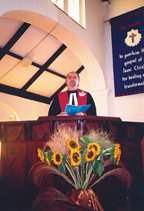
Soft-voiced but thickly accented, Ross Olivier, 49, is a man of dedication. He was dedicated when he led 23 congregations in apartheid-ridden South Africa, and he's dedicated now as the lead minister at Galloway United Methodist. Though he is only at Galloway for five years, "on loan from South Africa," as he explains it, Olivier is committed to engaging the church in social issues. He will comfort the afflicted, he says, but only while simultaneously afflicting the comfortable.
Comforting and afflicting are exactly what he has been doing for most of his adult life in South Africa. After growing up in boarding school and meeting his to-be wife, Shayne, at age 16, he completed two years of government-required army service training. In 1980, he entered the ministry, beginning his first church work in Heidelberg, a small town in a rural area. While ministering in Heidelberg, Olivier underwent a "moral conversion," embracing new values for the cause of justice. It is these values he brings with him to Mississippi, where he is once again dedicated to serving the people.
How did you find your way to Mississippi?
It was a constellation of coincidences. I had reached a point where I felt the need to withdraw from national church leadership and return to what is really my first love—working with people within a community. Over the last number of years, I had been helping congregations become transforming communities. I wanted to put into practice what I had been helping others learn to do.
At one point, you were in charge of 23 congregations. How did that work out?
With difficulty. Essentially, you get to see your congregations once a quarter. The resources in Africa are a lot more scarce than they are here, and so they're not available to invest to the same extent. The average minister just has many more people to look after, which changes the nature of the ministry. The whole design of ministry is about people empowerment and the development of lay people. In many places in Africa, the churches are run by laity, and ministers really just play a facilitating, nurturing role.
Four of your congregations were all white; 19 were all black. How do you balance congregations from different backgrounds? Does it matter?
It matters in the sense that you have to learn and come to understand the cultural differences. There are basic differences like languages. We have 11 different languages, and so in some of those communities, I could only preach with a translator. What it does is teach you to be very respectful of the differences between cultures, but also to recognize that those are secondary differences. On a primary level, you're speaking about humanity. We all belong to the same country. We came from the same soil. It was helpful because it meant that we became bridges between diverse community groups. That helped to mature and shape the ministry. That's why I think the church was able to be a bulwark against apartheid in that many of its ministers found themselves being trained by their congregations. That's the best kind of training—being trained by a community.
While you were there, you were very dedicated to justice. You have said this dedication distanced you from conservative members of the community. What values precipitated this distance?
You need to remember that many, many members of the white community had only ever known the ideology of apartheid. The entire state apparatus was designed to brainwash people into believing that apartheid was a justifiable social policy. People had been taught that at school, in their primary set of values that shaped their ideas and politics. As we presented the Gospel in ways that challenged the norm and invited people to see through the eyes of their faith, they could not subscribe to the political norms promoted by the state and still live comfortably with the teachings of Jesus. That created a conflict, but it was a healthy conflict. It enabled us to force people to ask serious questions about what they believe. Which was the higher calling in their life—was it the teaching of Christ or the teaching of ideologues? My experience was that though it created conflict for many, they grew through that conflict. There were always some who walked away from it, who took the easy route and called us communists or liberation theologians.
How did you reconcile this?
I try to do two things always. One is to be a pastor; the other is to be a prophet. I want to be a prophet pastorly and a pastor prophetically. I used to say to my congregation that I had two functions. One is to comfort the afflicted. I always tried to be as tender and loving a pastor as I could be, but I had another calling, which is to afflict the comfortable. To the extent that we as pastors maintain any integrity between both of those roles, people respond and engage. It's very difficult for many people, when the entire structure of a society promotes a certain viewpoint, to step outside that. For many, it's an invitation to break from their family traditions. They had to go against peer pressure. We were inviting people to step outside the prevailing cultural framework, to see society differently, to not look at society through color-coded eyes, to discover each other as human beings rather than as people from another racial identity.
Do you think anything similar is happening in the United States?
There's an ongoing struggle that the Church will always face, which is the issue of exclusionism. It's the only issue really that the Church has faced ever since its inception. In the book of Acts, the very first church described for us is about one thing—who's in and who's out. Is this a church for the Jews or for the Gentiles? Then it has been about male and female or slave and freeman. The Church has always had this struggle to admit more people into its ranks, but I've learned that God's grace is greater than the locks of the door on the church. Always, at the end of the struggle, the Church has had to understand that exclusivism and exclusionary practices somehow don't fit with the scheme of God.
All I'm doing at this time is observing the discourse in the United States. I haven't been here long enough to fully understand and interpret. One of the things I disliked intensely in South Africa is when folks would come from outside and become experts in a short time and tell us how to do our business. All I can do is observe, and as I observe, I have come to understand that I'm quite confused about how the discourse works here.
At one level, this is a society that prides itself on a so-called separation of church and state. Yet, as I looked at the processes of this last election, there seems to be a crossover between church and state, faith and politics, and spirituality and society. A lot of the debate was apparently about moral issues, but I'm not sure who defines what those moral issues are. It seems to me that, sometimes, it's a very narrow selection of moral issues. Poverty is a huge moral issue. Disparity, and any form of injustice, intolerance or disrespect, goes to the heart of the Christian ethic. The Christian ethic is defined by the most loaded four-letter word of all—love. A love that challenges people to love their enemies is so challenging. The line between issues of faith and ideological positions is going to need to be defined. At the moment, they're just becoming transfused.
In a recent column for the JFP, Lawrence Silver wrote, "The United States is not a Christian nation, and as a Christian, I hope it never becomes one." What do you think about that?
There is no such thing as a Christian nation anywhere in the world, and neither does there need to be. If we're thinking about theocracy, that would confront the very notion of the democratic values that we seem to believe. That would make the United States a Christian version of Iran or Afghanistan under the Taliban. That's what a theocracy looks like. However, if by that we mean that the totality of our lives, including the shaping of our political values, is somehow tied into our faith values, that's a different thing. When the apartheid ruled South Africa, they did so under the guise of being a Christian nation. It was projected as Christianity versus communism. The scary thing is that people perpetrated the atrocities of apartheid in the name of God. I've learned how easy it is to give God a bad name.
What trends have you observed thus far in Jackson?
I've really only been [at Galloway]. Generally speaking, though I would need to learn to understand whether my observation is correct, I think the Church here is less engaged with social issues and society than South Africa is. Maybe there's a historical reason for that that I don't know, but certainly in South Africa, the Church needed to fill the void that was left by imprisonment and exile of those who would have led the struggle against apartheid. There's less dualism between spirituality and society in an African context. I think that has to do with the understanding of community. The only real witness that a church can offer society is the witness of a communal life that reflects the message of Jesus.
You mentioned preferring to have a single congregation rather than traveling. Why is that?
It's my essential calling. I have been in one form or another of church leadership for 10 years. I want to be where the rubber meets the road—be in a community and journey with that community. Galloway is a fascinating community. It's downtown in a transitioning community. It's the oldest church in Jackson. It is needing to kind of reshape its identity and purpose for this change in time. I think it's an exciting opportunity to journey with this congregation, to see whether we can be a bridging, networking, resourcing community in the heart of the city.
What other goals do you have for Galloway?
I work on the basis that whatever needs to happen, I'll discover as it comes to me. I don't have any Messianic sorts of ideas. I didn't come here to change Jackson, but to serve it. If somehow in faithful serving, I can add something to the aspirations of the community to be a better, more whole community, then that would be wonderful. I'm just going to be faithful, and hopefully God will let that be fruitful.
What's one thing most people don't know about you?
I'm an absolute Elvis fanatic. One of the first things I did in Mississippi was make a pilgrimage to Tupelo to see Elvis' birthplace. I have absolutely no musical talent whatsoever. God left me devoid of any rhythm, but somehow Elvis is able to inspire in me an appreciation of music that nobody else can.
Previous Comments
- ID
- 77942
- Comment
always good things, casey!
- Author
- John Sawyer
- Date
- 2004-12-23T09:24:38-06:00
- ID
- 77943
- Comment
I agree, sawyer. This was an amazing interview. He had so many good things to say that it was a chore to decide which quotes to highlight. People like this give me so much hope in humankind.
- Author
- DonnaLadd
- Date
- 2004-12-23T13:23:44-06:00
More stories by this author
Support our reporting -- Follow the MFP.


Comments
Use the comment form below to begin a discussion about this content.
comments powered by Disqus