
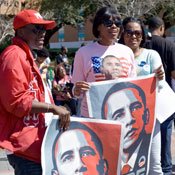
The economy, the war in Iraq and personal attacks have succeeded in slapping attention away from the nation's education issuenot an easy feat considering how highly communities generally rate education in political importance in polls.
An annual poll published by the Public Education Network, "Civic Index for Quality Public Education," revealed that rising prices and job losses were pushing education out of prominence as far back as June. Americans ranked education third at 19 percent, slightly above health care (11 percent), but lower than gas prices (22 percent) and the economy (19 percent).
Two years ago the PEN poll ranked education the most important issue. The percentage dropped 4 points in 2006 and another 12 percent this year. Lake Research Partners conducted that poll in Mayprior to the collapse of the housing market and the meltdown of several major lending institutions in August and September.
Still, 48 percent told the same pollster that a candidates' position on education is either "one of the most important" issues or a "very important" issue in helping them decide who they'll pick in November. (More respondents than in past polls also claimed the candidates were focusing too little on education as a major issue and charged the media with being skimpy on information.)
The U.S. Department of Education claims education funding increased under the Bush administration by almost 80 percent, though it makes little mention of Congress being the main source of the increase. Bush actually fought congressional attempts to increase the education budget several times.
Last year, for example, the president vetoed the Education Appropriations bill because it grew too much at the hands of congress. Congress proved unable to override the veto, costing the nation's educational system about $700 million.
Money Missing the Mark
Jackson Public Schools board member H. Ann Jones said the increased spending claimed by the U.S. Department of Education isn't adjusted for inflation in any case. The vital things that keep a school system running, like food and transportation, have exploded in cost. The Jackson school system raised the price for a daily lunch from $1.50 to $1.75 to counter the increase, and school buseseven urban buses with shorter driving routes gobble a lot of diesel.
"Believe it or not, our district buses travel enough miles in a year to travel to the moon and back," Jones said. "That's a lot of miles and a lot of gas."
The two presidential candidates share some views on how to improve education funding, most notably how to tweak Bush's No Child Left Behind program, which extols test-based learning, coupled with rigorous testing of school systems.
A September Gallup poll found that more than 40 percent of Americans also want to see changes in No Child Left Behind, while another quarter of those polled preferred to see the program vanish.
Neither of the candidates plans to let the NCLB expire, according to their Web sites, even though both have criticized it. Obama offers the most criticism, lashing the program as under-funded and unsupported by the administration that first devised it. He plans to put more financing to the plan, and conveys no desire to drop it's heavy reliance on standardized testing.
McCain actually voted for authorization of NCLB in 2001, and wants to provide more tutoring services for students who are falling behind on the program's strict definition of success before taking a hammer to it.
Obama also criticizes dependence on tests that he said are sometimes inadequately designed, according to campaign statements, and complains that the tests are narrowly focused on a handful of subjects rather than a balanced curriculum.
The Illinois senator said the tests should be localized to help teachers target individual students' problem subjects.
Susan Womack, executive director of Mississippi educational lobbying group Parents for Public Schools, warns that the tests amount to little more than constant drilling, which bores students.
"Testing is important, but there has to be more than just tests," she said. "Students need to be engaged, or they'll lose interest."
The New President's Priorities
The candidates dramatically part ways regarding funding NCLB and the importance of public schools verses alternative institutions.
McCain advocates more federal dollars to parents to finance private or religious schools. McCain's Web site encourages a free market economy, and applies the argument to education.
"Choice and competition is the key to success in education in America," McCain said during the December 2007 Republican primary debate, "That means charter schools; that means home schooling, it means vouchers, it means rewarding good teachers and finding bad teachers another line of work. It means rewarding good performing schools, and it really means in some cases putting bad performing schools out of business."
McCain specifically said that he wants to expand federally funded Opportunity Scholarship vouchers that allow parents to pick the school of their choice, be they public, private or religious-affiliated.
Obama also wants to give parents more options in picking a school for their children, but limits those choices to public charter schools, and does not support vouchers for children to attend private and parochial schools, as McCain does.
"I've consistently said we need to support charter schools," Obama told Politico in February. "I think it is important to experiment, by looking at how we can reward excellence in the classroom. ... I am a strong supporter of teachers, but I'm not going to be bound by just a certain way of talking about these things, in order for us to move forward on behalf of our kids."
McCain voted "no" on a 2005 amendment to the 2006 Fiscal Year Budget Resolution that would have shifted $10.8 billion from corporate tax loopholes to higher education. The bill would have restored education program cuts planned for vocational education, increased the maximum Pell Grant (a public college financing program) to $4,500, and increased math and science teacher student loan forgiveness plans to $23,000.
Unlike McCain, Obama supported the amendment. He also voted to approve a 2005 amendment to an appropriations bill that would have allotted $51.9 million to increase appropriations for after-school programs while cutting salaries and expenses in the U.S. Department of Labor.
McCain opposed that bill, and voted against another 2005 amendment that would have provided $5 billion to local educational agencies ($2.5 billion for targeting grants to local educational agencies and $2.5 billion for education finance incentive grants) through title I of the Elementary and Secondary Education Act of 1965.
Obama voted yes to that same bill.
Both candidates demand better training for teachers and advocate teacher merit pay.
Obama addressed the issue in his book, "The Audacity of Hope": "We are going to have to take the teaching profession seriously. This means paying teachers what they are worth," he wrote. "... In exchange for more money, teachers need to become more accountable for their performances, and school districts need to have greater ability to get rid of ineffective teachers."
McCain also offered full support for merit pay, responding in a 1999 Republican debate that he didn't "see why a good teacher should be paid less money than a bad senator."
"It's important that we have merit pay for teachers, that we have teacher testing, that we do everything we can to motivate young men and women to enter this profession. . . . It is unconscionable that the average salary of a lawyer is $79,000 a year and the average salary of a teacher is $39,000 a year," McCain said.
How the Advocates Lean
The National Education Association endorsed Obama earlier this year, and NEA President Dennis Van Roekel confirmed its assessment the day after the debate between vice presidential candidates Joe Biden and Sarah Palin.
"Sen. Joe Biden made it clear Thursday that the long-term plan for a healthy economy is to invest in public education and make a college education affordable," Roekel said.
"McCain supports NCLB, but opposes funding the law's mandates. He has voted against $5 billion for public schools, and his (suggested) freeze on spending (to cover the nation's expanding debt) would shortchange 4.2 million disadvantaged children of the reading and math help they need. That's not reform; that's more of the same," Roekel added.
NEA picked Obama, despite his stance on merit pay, which the union historically opposes. Obama told the unions that any alternative compensation system will be "done with teachers, not to them." Instead of the federal government dictating merit pay, compensation will be decided on the local level.
McCain, on the other hand, has said explicitly that individual school principals will make decisions on merit adjustments without any regard to collective bargaining. McCain told the NAACP in July that he considers teachers unions an impediment to quality public education.
"Obama dismissed public support for private-school vouchers for low-income Americans as, 'tired rhetoric about vouchers and school choice.' All of that went over well with the teachers union, but where does it leave families and their children who are stuck in failing schools?" McCain asked. Another reason unions support Obama is his bold statements on increasing public-education funding.
Republican Web site GOP.com boasts a multi-page "Obama Spend-O-Meter" that looks to scare taxpayers into voting against the senator's expensive priorities. The Web site points outand Obama's Web site confirmsthat the senator's "Early Education and K-12 package will cost $18 billion a year; equal to $72 billion over four years."
The Spend-O-Meter also claims Obama will "provide $25 million a year for states to develop early assessment programs to increase college readiness; equal to $100 million over four years," and that, if president, he "would provide $250 million to bring quality teachers back to the Gulf region."
It also claims Obama, based upon his past record, "will increase the maximum Pell Grant to $5,400 and ensure the grant keeps pace with the rising cost of college inflation."
To Jackson resident Helen Barnes, the Spend-O-Meter reads like a goody bag of responsible legislation that should have been enacted years ago.
"I hear what it says but all I can think is 'great idea,Ҕ Barnes told the Jackson Free Press. "You don't have to cut my taxes if it means more education. Education is of prime importance. Good education will cost less in other things, from health care to the court system.
More stories by this author
Support our reporting -- Follow the MFP.

Comments
Use the comment form below to begin a discussion about this content.
comments powered by Disqus